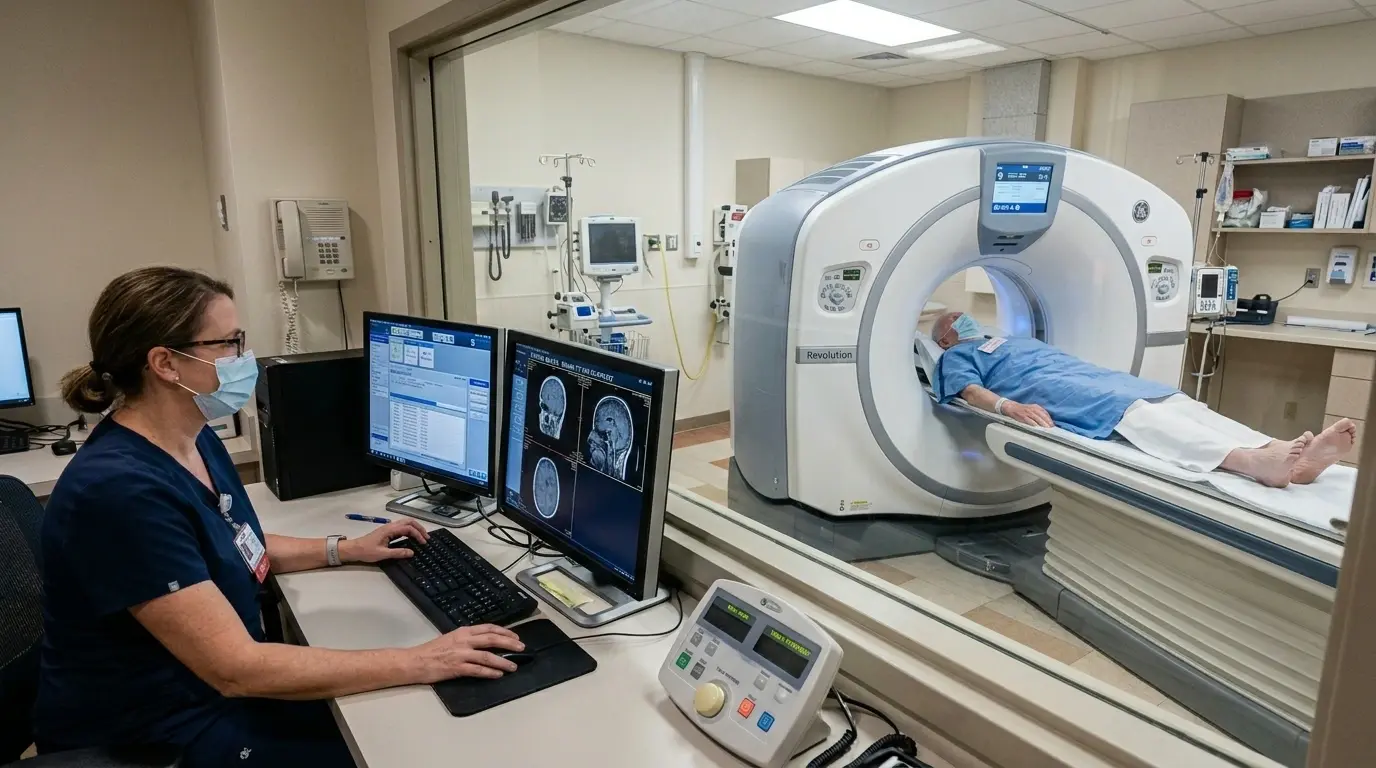
CPT Code 91035 refers to wireless esophageal pH monitoring using a Bravo™ capsule that is attached to the mucosa (the membrane lining the esophagus). For billing purposes, the time of service for CPT Code 91035 is the date of interpretation instead of placement. When reported same-day as EGD (43235) at the facility level, Modifier 59 is required per 2026 NCCI edits.
According to the American College of Gastroenterology (ACG) data, approximately 20% of adults in the United States suffer from GERD. Patients who are experiencing refractory symptoms, or atypical manifestations, or are being evaluated for surgical intervention need to have confirmation of acid reflux in order for their physician to make a diagnosis. The Bravo capsule is a device used to monitor the pH level (the amount of acid) within the esophagus of suspected cases of GERD, primarily because patients are unable to tolerate having a catheter placed in their noses.
This guide serves as a compliant, audit-defensible reference for gastroenterologists, GI coders, and compliance teams.
CPT Code 91035 – Description
The AMA CPT codebook categorizes CPT code 91035 in the Gastroesophageal Reflux Test Studies section. Its full descriptor reads: Esophagus, gastroesophageal reflux test; with mucosal attached telemetry pH electrode placement, recording, analysis, and interpretation.
CPT Code 91035 features a wireless, mucosal-contacting capsule that allows long-term measurement and monitoring of acid exposure. CPT91034, however, refers to a wired (transnasal) pH testing with a catheter attached to the nasal mucosa. CPT 91035 is typically preferred for patient comfort and its ability to record data for up to 96 hours, whereas 91034 is limited to a 24-hour wired connection.
The capsule is placed approximately 6 cm above the squamocolumnar junction (Z-line) per ACG placement standards, using endoscopy (EGD), and records acid exposure over 24 to 96 hours.
The pathologic acid exposure time (AET) is greater than 6% at pH less than 4, as described in the Lyon Consensus (updated 2024), and AETs between 4% and 6% are considered borderline qualification for diagnosis.
The unique features of CPT code 91035 include:
- pH monitoring is performed by attaching to the mucosa at the Z-line instead of through a transnasal catheter
- Documentation must include the Symptom Index (SI), Symptom Association Probability (SAP) to quantify the temporal relationship between the patient’s symptoms and reflux events.
- The technical aspects (placement and recording) and professional aspects (analysis) are covered by one bill under a global format
- Billed on the interpretation date, not the date of capsule placement
- Document a 7-to-14-day PPI washout period in the clinical record
- If ordered after a negative EGD or for patients with refractory GERD, then the medical necessity must be demonstrated.
The capsule is placed on Day 1 (EGD date) while the physician interprets the data 48–96 hours later. In this instance, CPT code 91035 is used, and the equipment is owned by the physician. When billing is performed separately, i.e. quality modifier 26 and technical modifier TC will be reported as well.
Scenarios Where CPT Code 91035 is Applicable
CPT Code 91035 for GERD with Failed PPI Therapy
A patient with confirmed GERD (ICD-10: K21.0) presents with persistent heartburn despite twice-daily PPI therapy for 12 weeks. Bravo pH monitoring will be performed following a documented PPI washout period, in order to determine the extent of acid exposure time, and medical necessity is particularly supported when the pH monitoring occurs after a negative endoscopy. CPT code 91035 is reported on the interpretation date, and Modifier 59 is appended to 43235 on the facility claim per 2026 NCCI requirements.
CPT Code 91035 for Pre-Operative Anti-Reflux Surgery Evaluation
A patient with chronic GERD is being considered for laparoscopic fundoplication. According to ACG Clinical Guidelines, Objective pH documentation is required prior to surgery. Bravo monitoring will be performed with the patient off PPIs with a documented PPI washout period, and the documented pathologic AET will be included in the note to support surgical candidacy. CPT code 91035 applies when documentation links the pH result to surgical candidacy determination.
CPT Code 91035 for Atypical and Extraesophageal GERD Manifestations
A patient arrives with a cough (ICD-10: R05.9), wheezing (ICD-10: R06.2), and laryngopharyngeal reflux (ICD-10: J39.3 that have not improved using the recommended patient treatment of inhalers only. The wireless pH readings have shown excess nighttime acid, therefore, 95% threshold, confirming pathologic reflux as the extraesophageal driver.
CPT code 91035 is reported on the interpretation date. ICD-10 codes R05.9, R06.2, or J39.3 support medical necessity depending on the primary documented indication.
CPT Code 91035 for Post-Bariatric Surgery Reflux Recurrence
A patient six months post Roux-en-Y gastric bypass presents with recurrent heartburn. A Bravo™ pH study confirms that the patient still has a significant amount of acidic exposure with a higher-than-normal DeMeester score. This information directly affects the plan to initiate treatment with PPIs. CPT code 91035 is appropriate using ICD-10 K91.89 or K21.0, depending on clinical documentation specificity.
Common Modifiers Used with CPT Code 91035
| Modifier | Clinical Scenario | Billing Impact |
| 26 | Physician interprets data but does not own the equipment (e.g., hospital setting) | Bills professional component only |
| TC | Facility provides equipment; physician interprets separately | Bills technical component only |
| 59 | 91035 reported same day as EGD (43235) on facility claim | Required per 2026 NCCI edits; appended to 43235 |
| 25 | Separately identifiable E/M service on same date | Appended to E/M code |
| 76 | Study repeated by same provider same date | Non-duplicate medically necessary repeat |
| 77 | Study repeated by different provider same date | Ensures separate provider reimbursement |
| 91 | Test repeated for independent clinical reasons | Distinguishes justified re-testing from billing error |
| 52 | Procedure reduced in scope | Proportional reimbursement reduction |
| 53 | Procedure discontinued due to patient safety | Protects provider from non-payment |
| 22 | Substantially greater complexity required | Supports additional reimbursement with written justification |
CPT Code 91035 – Medicare Reimbursement Guidelines
Medicare Part B provides CPT code 91035 coverage in accordance with medical necessity requirements. For CY 2026, the conversion factors that CMS has finalized are $33.57 for qualified alternative payment model participants and $33.40 for other non-APM clinicians.
Geographic area and whether the service was delivered in a facility or not will also impact reimbursement levels. Providers must confirm their rate via the CMS MPFS Lookup Tool and ensure they meet the MAC LCD criteria prior to billing.
Demonstrate Medical Necessity
Medical necessity will be established through the documentation that contains a qualifying diagnosis and how the pH test will impact clinical management. There are several indications in which CPT code 91035 may be billed; these include atypical GERD symptoms (chronic cough [R05], wheezing [R06.2], LPR) and assessment for esophageal acid exposure in patients being evaluated as bariatric surgical revision candidates.
Focus on Documentation Completeness
The following items must be submitted with each CPT code 91035 claim: prior PPI failure history, Bravo™ confirmation of mucosal attachment at the Z-line, monitoring length of time, AET %; DeMeester score; symmetry index (SI), symmetry assessment (SAP); total number of reflux episodes, and an interpretive report that has been signed and dated on the interpretation date. The two most common triggers for audits are missing signed reports or failure to confirm the wireless attachment method of the mucosa.
Understand Payer Policies
There are many commercial payers that consider wireless pH monitoring as an investigational procedure for some indications. The pre-authorization process differs from payer to payer. Providers should verify the payer’s specific coverage annually and obtain proper pre-authorization for any procedure that requires it.
Common Claim Denial Reasons for CPT Code 91035
| Denial Reason | Root Cause | Remediation |
| Medical necessity not established | No documentation of failed conservative management | Include a minimum 4-week PPI trial history and high ICD-10 specificity (e.g., K21.0) |
| Missing interpretive report | No signed interpretation on file | Ensure the physician signs and dates the formal interpretive report before claim submission |
| Incorrect date of service | 91035 submitted on placement date | Always bill on the data download/interpretation date, not the Day 1 capsule placement date |
| Unbundling error with 43235 | Modifier 59 missing on facility claim | Append Modifier 59 to 43235 to demonstrate that the EGD was a separate, identifiable service |
| 91034 and 91035 billed together | Both pH monitoring methods submitted for same encounter | Select only the method actually used — 91034 and 91035 are mutually exclusive; billing both triggers automatic NCCI denial |
| Procedure treated as investigational | Payer does not cover wireless pH for stated indication | Verify payer-specific LCDs; provide peer-reviewed clinical justification if the indication is atypical |
| Frequency limitation exceeded | Repeat testing submitted within payer-restricted interval | Document the specific clinical change — disease progression or treatment modification — driving the repeat test |
Comparisons with Related CPT Codes
| CPT Code | Monitoring Method | Key Differentiator |
| 91035 | Wireless Bravo™ capsule; Z-line attachment; 48–96 hours | Catheter-free; preferred for patients who cannot tolerate nasal catheters |
| 91034 | Transnasal catheter; 24 hours | Catheter-based; mutually exclusive with 91035 |
| 91037 | Combined pH-impedance nasal catheter | Detects acid and non-acid reflux; preferred for PPI failures |
| 91038 | Extended pH-impedance catheter | NCCI-bundled with 91034 |
| 91010 | High-resolution esophageal manometry | Assesses LES pressure; billable same day as 91035 without Modifier 59 |
Conclusion
CPT code 91035 demands precision across all compliance dimensions: Z-line attachment documentation, interpretation-date billing, NCCI-compliant EGD unbundling, and ICD-10 specificity with documented PPI washout and failed conservative management. Gaps in any of these areas can be the cause of denial and audit exposure. Missing written report, incorrect service date, and unbundled claims for EGD on the same day are the most common causes of denial for Nexus io within high volume GI practices. Nexus io AAPC certified coding experts have an extensive background in providing gastroenterology billing services related to everything from the Bravo™ pH monitoring service entry and NCCI edits to the denial appeals and MAC LCD compliance. Explore Nexus io medical billing services and connect with the team today to close revenue gaps before they compound.
Frequently Asked Questions
Does Medicare Cover CPT Code 91035?
CPT code 91035 is billable under Medicare Part B if certain conditions of medical necessity and applicable ICD-10 diagnosis are met. Providers are required to verify current MAC Local Coverage Determination criteria for appropriate billing, and also the 2026 locality adjusted rates under the Medicare Physician Fee Schedule.
Some of the more commonly accepted diagnoses for CPT code 91035 include K21.0, K21.9, R12 (Heartburn), R05 (Chronic Cough), R06.2 (Wheezing), J39.3 (Laryngopharyngeal Reflux), J45.x (Asthma associated with documented Extraesophageal Gastroesophageal Reflux), and K91.89 (Post-procedural GI Complication).
Can CPT Code 91035 Be Billed on the Same Day as EGD Code 43235?
Yes. When the EGD (esophagogastroduodenoscopy) is medically necessary and performed independently of the capsule, and not solely for placing the Bravo™ capsule. The modifier 59 will need to be appended to the 43235 at the facility level; however, CPT code 91035 should be reported on the date of the interpretation.
Are CPT Codes 91035 and 91034 Billable Together?
The two CPT codes function as mutually exclusive alternative methods for ambulatory esophageal pH monitoring; therefore, billing both codes would be contrary to NCCI bundled billing guidelines, as unbundling.
What Is the Billing Difference Between CPT Codes 91035 and 91037?
CPT 91035 measures pH using a wireless Bravo™ capsule, whereas 91037 measures both pH and intraluminal impedance using a nasal catheter; therefore, the use of 91037/91038 combined is preferred for patients continuing to have symptoms while on PPI therapy.