According to the American Association for the Study of Liver Diseases (AASLD), chronic liver disease and cirrhosis account for more than 40,000 deaths annually in the United States. These stats highlight the clinical urgency of accurate hepatic fibrosis staging.
Non-invasive liver stiffness evaluations have become a primary component of today’s gastroenterology practices. CPT Code 91200 is the billing code for non-invasive liver stiffness assessments. This code denotes liver elastography using shear wave (i.e., vibration) elastography with mechanical stimuli to produce data without visual images, along with their interpretations and reports for each test performed.
To effectively use this code, gastroenterology practices must have a basic understanding of the specific scope of the procedure being performed, modifier logic, the specificity of ICD-10 codes, payer-specific (local) coverage determinations (LCD), and proper documentation format. This guide serves as a compliant, audit-defensible coding reference for physicians, GI coders, and healthcare compliance teams.
CPT Code 91200 – Description
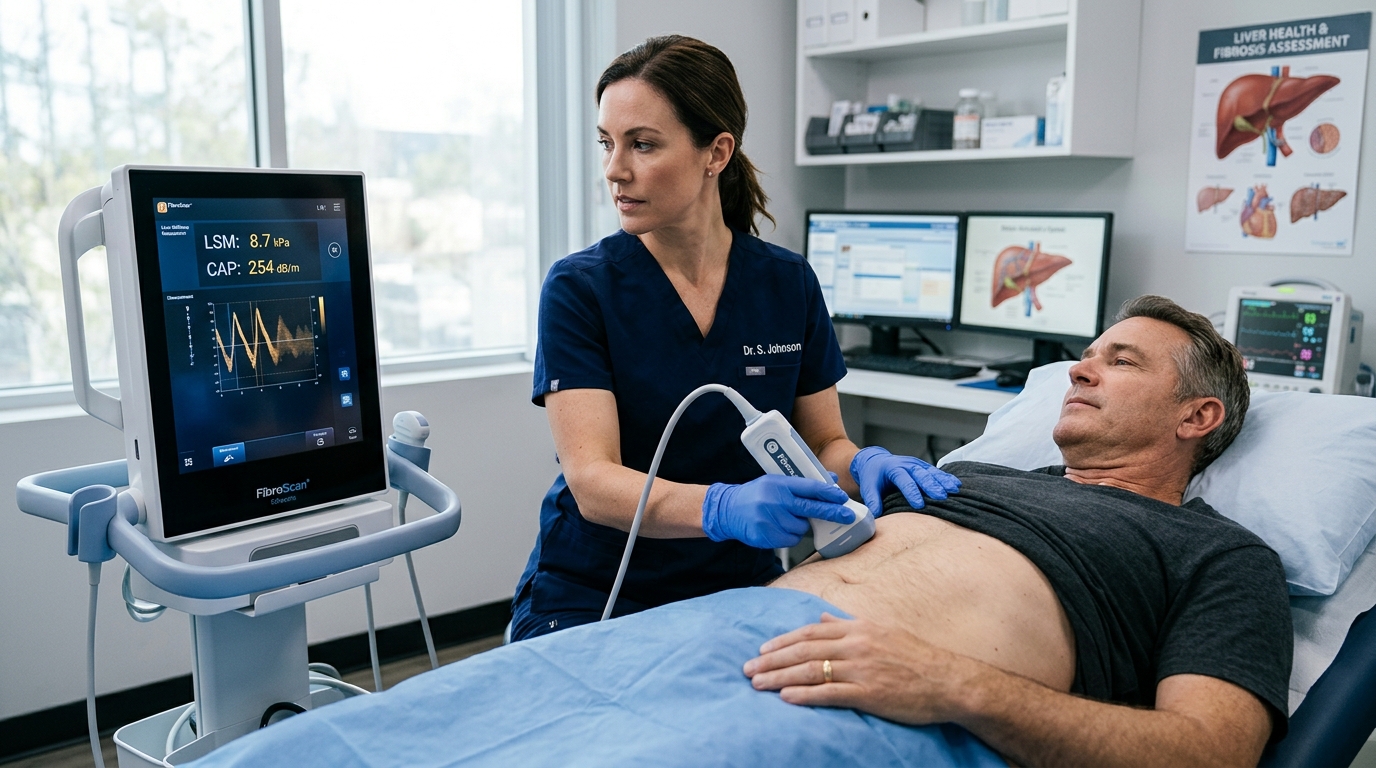
CPT code 91200 is classified under Other Diagnostic Gastroenterology Procedures in the AMA CPT codebook. It describes liver stiffness measurement performed through non-imaging vibration-controlled transient elastography (VCTE), commercially performed via the FibroScan® device.
CPT code 91200 for elastography has important distinguishing features compared to more common elastography codes, including:
- No B-mode imaging can be included in the medical record – please note this.
- The procedure includes technical performance of the procedure and physician interpretation and reporting when billed as a global bill; both must be documented in the medical record.
- Stiffness is defined by a numerical kPa value. An established staging system, such as METAVIR (staging criteria from F0 to F4) can be used to compare a patient’s stiffness kPa value with the published normal kPa range for liver tissue.
- Documentation of the interquartile range divided by median (IQR/M) must be provided, with an IQR/M of ≤0.30 expected to confirm the appropriate technical performance of this test.
Clinical research has validated the use of the FibroScan® elastography procedure as an effective diagnostic tool. FibroScan® has shown an accuracy of approximately 87% in detecting significant hepatic fibrosis and 91% in excluding advanced liver scarring. These data offer a strong medical necessity determination for the use of elastography in inpatient and outpatient settings.
Scenarios Where CPT Code 91200 is Applicable
Liver Fibrosis Staging in Chronic Viral Hepatitis
A patient who has chronic hepatitis C (ICD-10: B18.2) would require hepatic fibrosis staging before the doctors begin antiviral therapy. The gastroenterologist documents the rationale for deferring liver biopsy and orders VCTE instead.
Using CPT code 91200 for VCTE in this case is appropriate, and it is important to provide supporting documentation indicating that there should be no B-mode images ordered, the IQR/M ratio must be provided, and there must be linkage to the qualifying ICD-10. The same rationale applies when evaluating patients with either chronic hepatitis B (ICD-10: B18.0; B18.1).
NAFLD and NASH Treatment Response Monitoring
A patient with documented Non-Alcoholic Steatohepatitis (NASH) is currently undergoing a pharmacologic and lifestyle regimen and being monitored for treatment response via serial assessments of VCTE each year to monitor the patient’s fibrosis regression/progression.
Each assessment can be billed for separately using CPT code 91200. If there is a medical justification for a repeat assessment of VCTE on the same date (due to independent clinical reasons), modifier 91 should be applied. Each session’s documentation must support the service’s medical necessity on an individual basis and not be ordered based on routine clinical reflex alone.
Background Fibrosis Assessment in Chronic Alcoholic Liver Disease
A patient who has been diagnosed with chronic alcoholic liver disease (ICD-10: K70.x) is undergoing a pre-surgical evaluation to assess the risk of developing cirrhosis. Without performing a biopsy, the patient is going to have non-imaging elastography performed to quantify the hepatic fibrosis present on the patient.
The kPa is a direct result of quantifying the hepatic fibrosis, and it will guide the appropriate treatment pathway. CPT code 91200 will be the appropriate billing code, and ICD-10 coding on K70.0-K77, as well as R94.5 (abnormal liver function test), will support the medical necessity for services rendered
Evaluating Benign vs. Malignant Hepatic Lesions
Imaging has detected a concerning liver mass located in a person who has chronic liver disease. Non-imaging elastography of the liver is being ordered to assess the overall hepatic stiffness and overall co-factor risk for cancer.
If the non-imaging (91200) elastography is evaluating for overall liver stiffness, the report must include a clear link between the clinical objective and the coded diagnosis. If the elastography is lesion-specific (76982) and performed with concurrent ultrasound imaging, then the report should not use (91200) as the code.
Common Modifiers Used with CPT Code 91200
The following modifiers govern accurate claim submission and prevent NCCI bundling errors:
| Modifier | Clinical Scenario | Billing Impact |
| 26 | Physician interprets results only; does not own or operate equipment | Bills professional component only |
| TC | Facility/technician performs procedure; physician’s interpretation is separate | Bills technical component only |
| 59 | VCTE is rendered as a distinct service alongside other same-day procedures | Prevents improper bundling |
| 76 | Procedure repeated by the same provider on the same date due to technical necessity | Signals non-duplicate, medically necessary repeat |
| 77 | Procedure repeated by a different clinician on the same date | Documents separate provider, same-day repeat |
| 91 | Test repeated for independent clinical reasons on the same date | Indicates clinically justified, not a billing error |
| 52 | Procedure partially completed due to patient or equipment limitations | Reduces reimbursement proportionally |
| 53 | The procedure started but was discontinued due to patient safety concerns. | Protects the provider from non-payment for incomplete service |
| 22 | The procedure required substantially greater time, effort, or resources | Supports additional reimbursement with written justification |
| 25 | Separately identifiable E/M service provided on the same date as 91200 | Prevents bundling of E/M into the procedure fee |
When the physician and facility split the global service, Modifier 26 and Modifier TC must never appear on the same claim line. Each component is submitted independently.
CPT Code 91200 – Medicare Reimbursement
CPT code 91200 is a covered service under Medicare Part B when medical necessity criteria are met. Reimbursement is governed by the Medicare Physician Fee Schedule (MPFS). In the recently published CY 2026 reimbursement report, CMS has determined that the conversion factor is $33.57 for participants in qualified Advanced Alternative Payment Models (APM) and $33.40 for other eligible physicians, which will result in a Congressional increase of 2.5% over the 2025 rates.
The payment rate for CPT 91200 may vary depending on geographic Practice Expense adjustment, GPCI value, and if billed in a facility or non-facility setting. The current rate should also be verified by utilizing the CMS MPFS Look-Up Tool and checking against each respective MAC Local Coverage Determination (LCD).
Medical Necessity
To establish medical necessity, documentation must have an appropriate ICD-10 diagnosis and specify how the liver stiffness result applies to clinical management. The clinical note should provide the following:
- ICD-10 references that confirm a chronic liver disease diagnosis
- Justification for selecting VCTE (non-imaging), rather than biopsies or imaging elastography
- The effect of the result (from the procedure) on the patient’s treatment regimen
Coverage for claims under major commercial payers is generally limited to chronic hepatitis B, C, alcoholic liver disease, and other chronic liver diseases under active clinical management.
Focus on Documentation Completeness
To submit an itemized claim with CPT Code 91200 requires complete documentation of the following items in your clinical records:
- Confirmation that no B-mode ultrasound was performed
- The number of valid acquisitions for testing (typically 10)
- The liver stiffness score, expressed in kilopascals (kPa)
- The IQR/M ratio, with a value of less than or equal to 0.30, shows technical adequacy.
- The written report from the physician interpreting the results of this test for fibrotic staging
- The written report from the physician should be physically included in the medical record.
If any of the above items are not documented as part of your claim’s documentation, then the claim will be flagged as under-documented, creating exposure to post-payment audit recoupments.
Understand Payer Policies
Medicare Advantage plans, commercial payers, and Medicaid programs apply independent coverage criteria to CPT code 91200. Most major commercial payers limit the frequency of this test to every 12 months, unless the patient has documentation of disease progression. Additionally, pre-authorizations vary by payer type and region.
Providers should review payer-specific LCD documents on a quarterly basis since the criteria for the use of non-invasive liver disease assessment devices change frequently.
Claim Denial Reasons for CPT Code 91200
Claims submitted for CPT code 91200 are subject to several predictable denial patterns, each with a distinct remediation pathway.
| Denial Reason | Root Cause | Remediation |
| Medical necessity not established | No ICD-10 diagnosis code linked to a qualifying chronic liver condition | Attach clinical note with explicit ICD-10 specificity (e.g., B18.2, K70.10) |
| Missing interpretive report | Procedure performed; no signed written report on file | A physician must generate and sign the report before claim submission |
| Imaging absence not documented | The record does not confirm the non-imaging technique | Add explicit notation: “VCTE performed without B-mode imaging.” |
| Incorrect modifier selection | Global code billed when split-component applies, or vice versa | Confirm equipment ownership; split with Modifier 26 / TC as applicable |
| Duplicate claim without a modifier | Repeat same-day testing submitted without Modifier 76 or 91 | Resubmit with the appropriate modifier and written clinical justification |
| Non-covered indication | The ICD-10 code falls outside the payer’s covered diagnosis list | Verify covered diagnoses per MAC LCD; correct ICD-10 if inaccurate |
| Frequency limitation exceeded | Testing interval does not meet payer-specific repeat frequency policy | Document disease progression or treatment change, justifying early repeat |
Comparisons with Related CPT Codes
Understanding the boundaries of CPT code 91200 requires familiarity with adjacent elastography codes. Misapplication, particularly substituting 91200 for 76981, is a common audit finding.
| CPT Code | Full Descriptor | Imaging? | Key Differentiator |
| 91200 | Liver stiffness measurement via non-imaging mechanically induced shear wave (VCTE), with interpretation and report | No | Non-imaging VCTE only; FibroScan® prototypical device; global liver assessment |
| 76981 | Ultrasound elastography; parenchyma (e.g., organ) | Yes | B-mode imaging is concurrent; real-time shear wave or strain elastography |
| 76982 | Ultrasound elastography; first target lesion | Yes | Lesion-specific; requires imaging; used for hepatic mass characterization |
| 76983 | Ultrasound elastography; each additional target lesion | Yes | Add-on to 76982; cannot be reported without a primary 76982 claim |
CPT codes 91200 and 76981 are also considered mutually exclusive. If ultrasound imaging is done real-time with elastography, then CPT code 76981 should be reported and the CPT code 91200 will not be used. Payer audits often review claims where the CPT code 91200 is used and the procedure note states that concurrent imaging is performed.
CPT Code 0346T which was previously reported for vibration elastography (i.e., done without any imaging) has since been deleted and incorporated into 91200. All provider charge templates should be updated so that CPT Code 0346T does not appear on any active charge templates.
Conclusion
The CPT Code 91200 is important both clinically and financially because it allows for a non-invasive assessment of hepatic fibrosis in gastroenterology and hepatology practices. Correctly billing for CPT Code 91200 requires accurate reporting along four distinct dimensions: 1) Precise procedure identification (non-imaging VCTE); 2) Completeness of documentation (kPa, IQR/M, provider’s signature, non-imaging); 3) Accurate use of modifiers (global or component); and 4) Specification of the ICD-10 code (the qualifying chronic liver disease diagnoses).
If there were to be a gap in one of these four elements, it would result in an eventual denial of payment by the payer or underpayment, and would also create a practice that is vulnerable to audit.
Nexus io has an AAPC-certified billing team dedicated to providing gastroenterology billing services to help GI practices preserve revenue through all phases of the claim lifecycle, including FibroScan® charge entry and modifier validation, denial appeal management, and MAC LCD compliance. Nexus io provides the precision and turnaround requirements that high-volume practices can expect. You can learn more about Nexus io’s medical billing services or contact them today to benchmark your current CPT code 91200 claims performance and identify trends of underpayment.
Frequently Asked Questions
Is CPT code 91200 covered by Medicare?
Medicare Part B will cover CPT code 91200; however, the claim must have both a valid ICD-10 code and sufficient documentation supporting the claim. Coverage criteria are established by the local coverage determination (LCD) of each Medicare Administrative Contractor (MAC).
Therefore, providers are encouraged to check both the national Medicare Physician Fee Schedule (MPFS) and their jurisdiction-specific LCD to verify what they are currently covered for and what limitations apply to the frequency of those coverage decisions.
What ICD-10 codes support CPT code 91200?
Major payers’ payment policies specify the qualifying ICD-10 diagnosis codes for CPT code 91200. Each MAC’s LCD also identifies these codes. The qualifying codes include B18.0, B18.1, B18.2, B18.8, and B18.9 for chronic viral hepatitis.
Acute viral hepatitis diagnosis codes include B19.0, B19.1, and B19.2; and general liver disease can be coded with K70.0 to K77. Abnormal liver test results are covered by code R94.5. All services billed to CPT code 91200 must contain the highest level of ICD-10 specificity.
Can CPT code 91200 be billed on the same day as an E/M service?
Yes, provided the E/M service is separately identifiable and not solely related to the elastography encounter. Modifier 25 must be appended to the E/M code to signal a distinct, significant service.
What is the key documentation difference between CPT 91200 and 76981?
The use of CPT code 91200 will be determined by the presence or absence of simultaneous B-Mode imaging. If CPT code 91200 is used, documentation should clearly indicate that no imaging was utilized.